
Clorox Faces Class Action Over Recalled Mistolin and Lestoil Cleaners
October 6, 2026

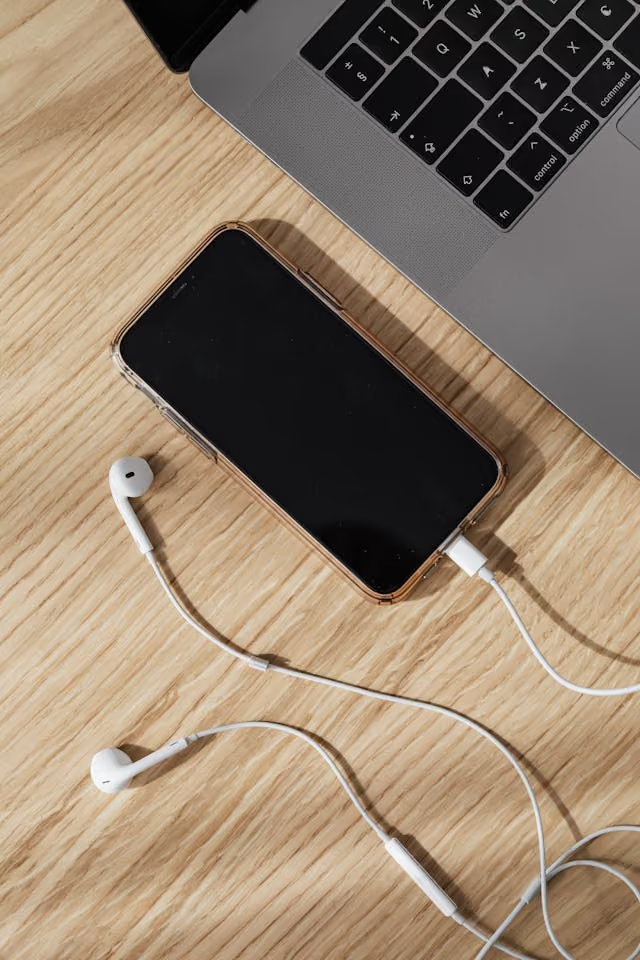
Here is a scenario that once seemed odd but now is all too common: you are having a private conversation at home and you mention needing new running shoes. Within hours, your social media feeds fill with sneaker ads. Coincidence? It is clear that the devices in our homes are not only recording us, but the Big Tech behind the scenes are profiting from that data without ever asking permission.
At The Lyon Firm, we are actively investigating data privacy claims involving AI-powered ambient recording, and we want you to share your own stories.
Ambient recording refers to the passive or near-continuous capture of audio or behavioral signals by a device or application, often without the user's active awareness. This is distinct from you pressing a button to record something. Instead, apps and connected home devices may be harvesting conversational context in the background.
Historically, this technology was marketed as a convenience feature with voice assistants like Siri, Alexa, and Google Assistant designed to remain in a low-power "listening state" waiting for a trigger phrase. But it seems it has become something we are not choosing to use, it is choosing to use us.
Several powerful federal and state statutes may apply when companies secretly record or use your private conversations.
The Federal Wiretap Act prohibits the intentional interception of electronic communications without consent and violations can result in both criminal penalties and civil liability. Courts have applied this statute to digital communications, and plaintiffs in several pending AI cases have invoked it directly.
The California Invasion of Privacy Act (CIPA) requires all parties to a conversation to consent before recording. California courts have applied CIPA broadly in the digital context, and several class action suits against major technology companies have been brought under this framework.
The Illinois Biometric Information Privacy Act (BIPA) is among the most aggressively litigated privacy statutes in the country. BIPA focuses primarily on biometric identifiers like fingerprints and facial geometry, and its underlying framework has influenced courts across multiple jurisdictions and inspired similar legislation in other states.
The recently enacted California Privacy Rights Act (CPRA), which substantially expanded the California Consumer Privacy Act (CCPA), grants consumers the right to know what personal information is being collected, the right to delete that information, and the right to opt out of its sale or sharing.
If you live in a two-party consent state like California, Florida, Illinois and Pennsylvania, a company that records your voice without your knowledge may have violated state law regardless of whether federal statutes apply.
In 2023, Meta faced a proposed class action in federal court alleging that its platforms used device microphones to capture ambient audio for targeted advertising. Amazon has faced repeated scrutiny over how Alexa processes and stores voice recordings, resulting in a $25 million settlement with the Federal Trade Commission in 2023.
Apple has also faced legal exposure following reporting that Siri recordings were reviewed by contractors without user awareness. A class action settlement in that matter was reached in 2024 and Google has faced parallel allegations related to its Assistant platform and smart home devices.
Plaintiffs in newly filed suits are alleging that captured audio was fed into AI machine learning pipeline without meaningful disclosure or consent. This transforms a wiretapping claim into an unjust enrichment claim and a systemic violation of consumer protection law.
You may have a viable legal claim if you own or have owned an Amazon Echo, Google Nest, Apple HomePod, or similar smart speaker; you use a smartphone with Siri, Google Assistant, or Alexa enabled; you have noticed suspiciously specific advertisements appearing shortly after private verbal conversations; you use a mobile app that requested microphone access for purposes unrelated to recording; or you received a privacy policy update or data breach notice from a tech company mentioning voice data or AI training datasets.
The Lyon Firm handles these matters on a contingency fee basis and you pay nothing unless we recover for you. Our process begins with a confidential, no-obligation consultation where you speak directly with an attorney who will evaluate your situation and advise you on the most viable path forward.
If enough individuals with similar experiences come forward, we may pursue collective or class action litigation that maximizes recovery and drives real accountability. Your case may have an important outcome for millions of others whose conversations were captured without consent.
If you believe a company secretly recorded your conversations or used your voice data to train AI systems without your knowledge or consent, you may be entitled to compensation. Contact The Lyon Firm today for a free, confidential case evaluation.
The Lyon Firm is a Cincinnati, Ohio-based law firm, representing individuals nationwide in class action, product liability, and toxic exposure litigation.

Taking the first step doesn’t have to be complicated. In just a few minutes, you can share the basics of your case, and our team will guide you from there: