
Clorox Faces Class Action Over Recalled Mistolin and Lestoil Cleaners
October 6, 2026

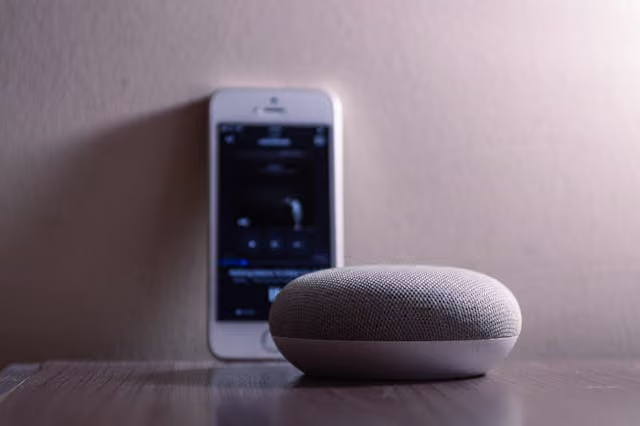
The consumer privacy lawyers at The Lyon Firm are investigating unique personal privacy violations involving software that provides AI robocall and AI call monitoring services.
Some AI TCPA lawsuits have been filed on behalf of plaintiffs nationwide following privacy intrusions. Contact The Lyon Firm to learn more about AI call monitoring that may violate existing wiretapping laws.
AI call monitoring involves the use of machine learning and natural language processing (NLP) to automatically review phone conversations. These systems can flag fraud and evaluate employee performance. These platforms often analyze calls in real-time, drawing insights from conversation patterns.
AI call monitoring is legal, but companies who engage in any call monitoring are subject to state privacy statutes and other legal considerations. Telemarketers must adhere to federal and state wiretapping laws, which vary in their respective consent requirements.
Federal law requires only one-party consent (one party knows and agrees to the recording), but some states, such as California (CIPA), Delaware, Florida, Illinois, Maryland, Massachusetts, Montana, Nevada, New Hampshire, Pennsylvania, and Washington, require two-party consent, which means everyone on the call must consent to the recording or monitoring.
AI call monitoring often involves collecting sensitive personal information such as financial details or biometric data (like voiceprints). This triggers obligations under privacy laws like the California Consumer Privacy Act (CCPA) and the California Privacy Rights Act (CPRA).
Companies must ensure secure storage and proper notice to consumers about how their data is used.

TCPA laws and wiretapping laws have been cited in some AI call monitoring lawsuits, such as the following:
The Lyon Firm has extensive experience in TCPA litigation and consumer privacy law. We have represented thousands of clients in privacy-related cases and understand how to build wiretap and TCPA class actions against both the companies deploying AI tools and the vendors supplying them.
These cases are often well-suited for class treatment because the same AI system may have been used to record hundreds of thousands of calls under the same disclosure practices.
We handle these cases on contingency. No fees or costs until we recover on your behalf. If you believe your calls were recorded or monitored by AI without proper consent, contact The Lyon Firm today for a free consultation.
Is it legal for a company to record calls using AI? It can be legal, but only with proper consent. If proper consent was not obtained, the recording may be unlawful.
What are TCPA damages for AI robocalls? TCPA violations can result in statutory damages of $500 per call, increasing to $1,500 per call for willful violations.
Can I sue if an AI vendor analyzed my call without my knowledge? Courts have found that sharing call recordings with third-party AI platforms for analysis may require additional disclosures beyond a basic recording notice.
The Lyon Firm is a Cincinnati, Ohio-based law firm, representing individuals nationwide in class action, product liability, and toxic exposure litigation.
Taking the first step doesn’t have to be complicated. In just a few minutes, you can share the basics of your case, and our team will guide you from there: