Clorox Faces Class Action Over Recalled Mistolin and Lestoil Cleaners
October 6, 2026



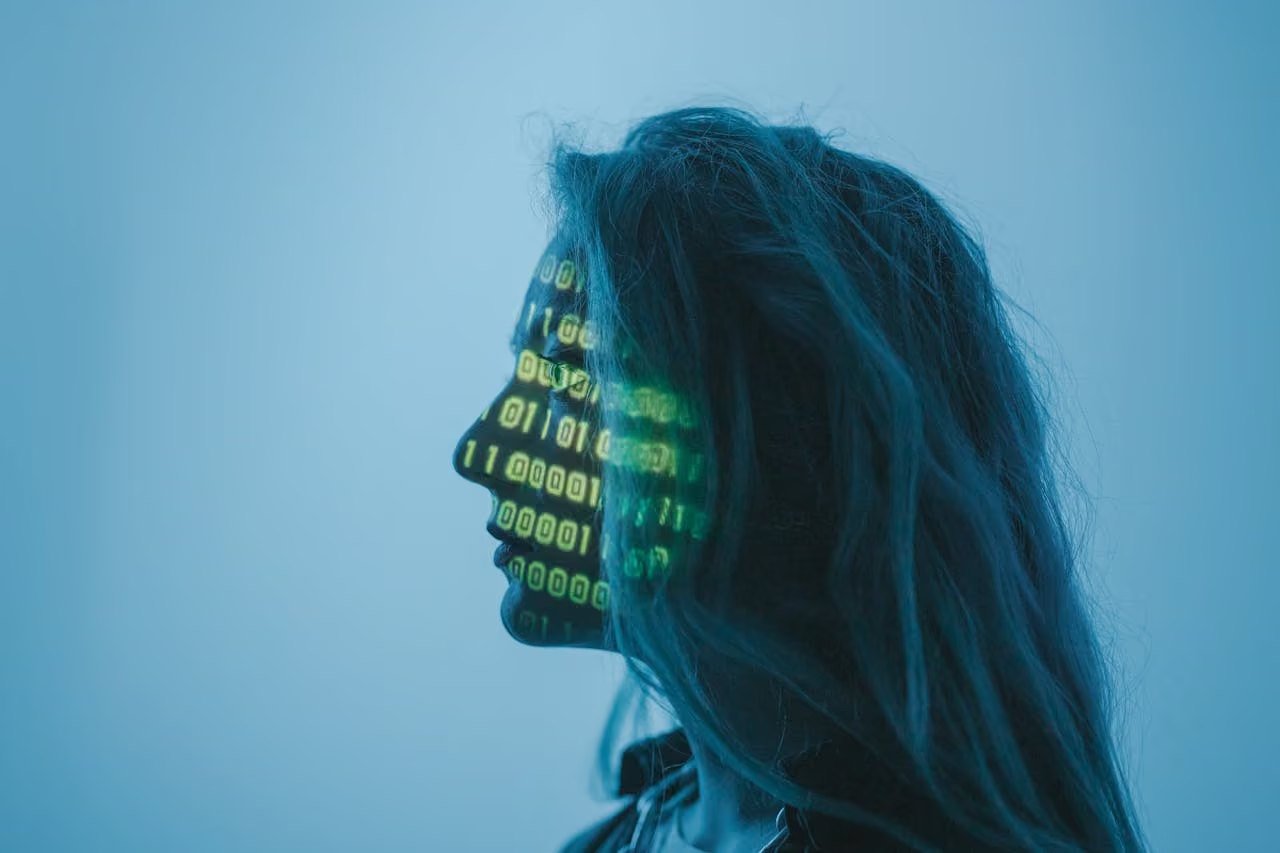
Among the most pressing legal concerns in the field of data privacy is the rise of AI-powered tools that capture biometric information, often without notice or consent. From facial recognition platforms and wearable health devices to clinical AI systems and consumer genomics applications, companies across nearly every sector are ingesting biological data at a scale that the legal system is still working to contain.
AI-driven data collection is regulated by the Illinois Biometric Information Privacy Act (BIPA) and the Genetic Information Privacy Act (GIPA). If your biometric or genetic information was shared without your written authorization, you may have valid legal claims, regardless of whether you suffered financial harm.
AI genetic data capture refers to the automated collection and analysis of biological identifiers that are either genetically derived or unique to a specific individual. This includes genetic signals from facial geometry, iris scans, voiceprints, gait analysis, and continuous physiological monitoring.
When an AI platform maps the contours of a human face during onboarding, it may be generating a biometric template that doubles as an ancestry or health inference engine. When a wearable device transmits real-time heart rate variability and skin conductance data to a cloud algorithm, that data may be feeding predictive models capable of inferring hereditary disease risk.
The boundary between traditional biometric collection and functional genetic capture is eroding, and companies that ignore consent obligations can be held accountable.
BIPA requires private entities to provide written notice, obtain informed written consent, publish a data retention policy, and refrain from profiting from biometric data before any collection occurs. It provides a private right of action with statutory damages of $1,000 per negligent violation and $5,000 per intentional or reckless violation.
GIPA governs the collection of genetic testing information by healthcare providers and other entities. It prohibits employers from conditioning employment on genetic testing and bars insurers from using genetic data in underwriting decisions. As AI systems grow capable of inferring genetic characteristics from non-genetic inputs, GIPA's reach is expanding well beyond its original consumer DNA testing context. Penalties reach $2,500 for negligent violations and $15,000 for intentional ones.
What makes the intersection of AI, BIPA, and GIPA uniquely dangerous for violating companies is that a single AI deployment may trigger violations under both statutes simultaneously.

Courts have issued a few landmark decisions over the past three years that define the scope of liability for AI-driven biometric and genetic data collection. Understanding these rulings is essential context for any potential claimant.
Cothron v. White Castle System, Inc. (Ill. Supreme Court, 2023) In what became the most consequential BIPA ruling of the decade, the Illinois Supreme Court held that a separate violation accrues each time a private entity collects or transmits biometric data without consent. White Castle's fingerprint-based employee system exposed the company to an estimated $17 billion in aggregate liability.
The ruling triggered a 65 percent surge in BIPA filings almost immediately. While the 2024 legislative amendment later capped this to one recovery per person per method of collection, Cothron established that AI systems collecting biometric data on a recurring basis face compounding legal exposure.
Tims v. Black Horse Carriers, Inc. (Ill. Supreme Court, 2023) This decision resolved a long-running dispute over which statute of limitations applies to BIPA claims. The Illinois Supreme Court held that a uniform five-year limitations period governs all BIPA violations. For plaintiffs whose biometric data was captured by AI systems as far back as early 2020, this ruling substantially extends the window to file suit and recover damages.
Zellmer v. Meta Platforms, Inc. (9th Cir., 2024) The Ninth Circuit affirmed dismissal of a BIPA claim against Meta involving the company's AI-powered "Tag Suggestions" feature, which generated internal "face signatures" from uploaded photos. The court held that to qualify as a biometric identifier under BIPA, the captured data must actually be capable of identifying an individual.
Because Meta's face signatures could not independently identify a person, they fell outside the statute's reach. This ruling established that AI systems that generate biometric proxies without a direct identification function may avoid BIPA coverage.
Tibbs v. Arlo Technologies (N.D. Ill., 2024) In a significant win for plaintiffs, a federal district court allowed BIPA claims to proceed against smart home AI company Arlo Technologies, whose doorbell and security camera systems used infrared and visible light scanning to map face geometry. This decision is especially relevant to AI robotics and home security companies deploying machine vision systems.
Cisneros v. Nuance Communications, Inc. (7th Cir., 2025) Nuance, a healthcare and enterprise AI company, faced BIPA claims over its voiceprint identification system used in financial advisory call centers. The district court dismissed the case but the plaintiff appealed. The outcome will have implications for AI companies operating across healthcare and financial sectors that process voice data for identity verification.
GIPA Litigation Surge (2023–2025) More than 100 GIPA class actions were filed between 2023 and early 2025 and courts have been receptive to these claims. As AI-assisted hiring tools begin incorporating predictive health screening components, GIPA's application to algorithmic hiring decisions is a rapidly developing area of law.
All BIPA claims are subject to a five-year statute of limitations in Illinois. For GIPA claims, the standard five-year limitations period for civil statutory violations also applies, so individuals whose biometric or genetic data was collected without consent as far back as 2021 may still have viable claims today.
Do I need to prove I was financially harmed to bring an AI Genetic Capture Privacy claim?
Both statutes allow claims based on the unconsented collection or use of protected data itself. Courts have consistently recognized that the violation of your privacy rights constitutes a cognizable injury without any accompanying financial loss.
What counts as biometric data in an AI context?
BIPA covers fingerprints, retina and iris scans, voiceprints, and scans of face or hand geometry. AI-generated biometric data qualifies if it can be used to identify a specific individual, and meaning many machine vision and facial mapping systems used in consumer electronics, security, and healthcare fall within the statute's reach.
What if the AI company is headquartered outside Illinois?
BIPA and GIPA apply based on where the data subject is located at the time of collection, not where the company is incorporated or headquartered. Illinois residents whose biometric or genetic data is collected by out-of-state AI companies have pursued claims under both statutes.
How much could my claim be worth?
Under BIPA, statutory damages are $1,000 per negligent violation and $5,000 per intentional or reckless violation, now capped at one recovery per person for the same collection method following the 2024 amendment. Under GIPA, damages reach $2,500 for negligent violations and $15,000 for intentional ones.
The Lyon Firm has built a focused national practice in biometric and genetic data privacy litigation, with experience filing data privacy class actions. Our attorneys understand both the technical architecture of AI data collection systems and the procedural demands of privacy class action litigation.
We represent clients exclusively on a contingency fee basis. You pay nothing unless we recover compensation on your behalf. If your biometric or genetic data was collected without your written consent, contact The Lyon Firm today for a free and confidential case evaluation.
The Lyon Firm is a Cincinnati, Ohio-based law firm, representing individuals nationwide in class action, product liability, and toxic exposure litigation.

Taking the first step doesn’t have to be complicated. In just a few minutes, you can share the basics of your case, and our team will guide you from there: