
Nuflos Complaints: What Consumers Should Know About Automatic Refills
October 7, 2026


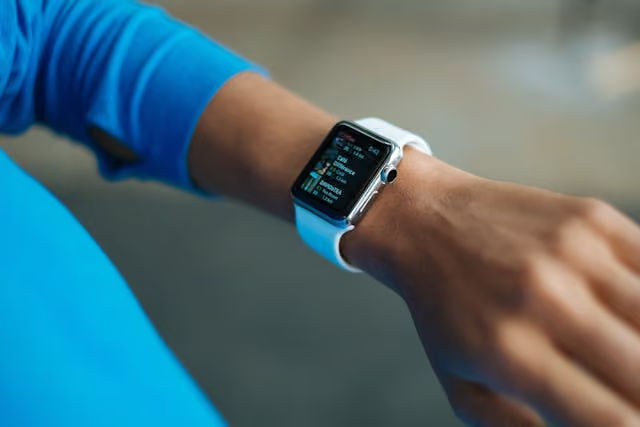
Your smartwatch knows your resting heart rate. Your fitness tracker logs your sleep cycles. Your glucose monitor shares data with an app on your phone. Millions of Americans now wear devices that collect intimate health information around the clock, but most users have no idea where that data goes after it leaves their wrist.
The legal framework governing wearable health devices and biometric data privacy is still catching up to the technology. But that does not mean consumers are without rights. Laws like the Illinois Biometric Information Privacy Act (BIPA) and the California Consumer Privacy Act (CCPA) are giving individuals real tools to hold companies accountable when their most personal data is mishandled. If you have ever worn a fitness tracker, smartwatch, continuous glucose monitor, or any health-sensing wearable, this article explains what you can do if those rights have been violated.
Modern wearable devices go far beyond step counts. The data harvested by these platforms increasingly falls into the category of biometric data, which are unique physical or behavioral characteristics that identify an individual. This can include heart rate and cardiac rhythms, blood oxygen saturation, sleep staging and duration, skin temperature fluctuations, electrodermal activity and stress indicators, menstrual cycle tracking, and ECG readings.
Legal scholars and litigants are now arguing that health metrics captured continuously over time can function as biometric identifiers because they form a biological fingerprint unique to each user. Courts are working through these questions, and The Lyon Firm is keeping close tabs on the developments.
Litigation involving wearable devices and health data is accelerating. Several recent cases illustrate where legal exposure is developing and what consumers have at stake.
Once your biometric profile exists in the wild, it cannot be changed. You can get a new password. You cannot get new fingerprints. You cannot change your unique cardiac signature. The permanence of biometric data makes its exposure categorically more harmful than most other privacy violations.
Health data collected by wearables can be used by data brokers in ways that may affect your insurance coverage or creditworthiness. Sleep disorder data could affect life insurance underwriting. Cardiac irregularity data, if exposed, could make you a target for health insurance discrimination.
Concerned Your Wearable Data Privacy Rights Have Been Violated? Contact The Lyon Firm today for a free, confidential case evaluation. Our attorneys handle BIPA claims and health data privacy cases nationwide.
The Federal Trade Commission has signaled clearly that health data collected by consumer apps and wearable-adjacent platforms is not beyond its reach. In 2023, the FTC took action against GoodRx, a health technology company, for sharing users' sensitive prescription and health data without authorization.
Similarly, the FTC pursued BetterHelp, an online therapy platform, for disclosing users' mental health data to Facebook and Snapchat for advertising retargeting. BetterHelp agreed to a $7.8 million settlement.
The FTC's enforcement trajectory suggests that companies collecting biometric and health data through wearables face growing federal scrutiny.
A growing segment of the wearable market targets children, and fitness trackers and health monitors are marketed to parents for monitoring their kids' activity or location. The Children's Online Privacy Protection Act (COPPA) prohibits the collection of personal information from children under 13 without verifiable parental consent, and the FTC has consistently interpreted this to include location data and health information.
In 2018, the FTC brought an action against VTech Holdings after a data breach exposed personal information of millions of children, including voice recordings and photos collected through connected devices. The case resulted in a $650,000 civil penalty.
Parents who purchased wearable devices for their children and later discovered that the platform was collecting biometric or location data without adequate COPPA-compliant consent may have viable claims. Given that children's biometric data carries the same permanence risks as adult data, and that children cannot meaningfully consent to its collection, courts and regulators treat violations in this space with particular seriousness. If your child's health or location data has been collected without your informed consent, contact The Lyon Firm to discuss your legal options.
Most wearable device users understand that their data goes to the app on their phone. Far fewer understand where it goes next. A sprawling and largely unregulated data broker industry purchases and resells health-adjacent data derived from consumer devices. These brokers compile detailed profiles that can include inferred health conditions, all derived from wearable sensor readings that users believed were private.
If you have reason to believe your wearable health data was sold to third parties or data brokers without your consent, you may have a claim under state or federal consumer protection law. An attorney experienced in health data privacy can evaluate the specific facts of your situation and advise on the best path forward.

Can I sue a wearable company for collecting my biometric data without consent?
If you are an Illinois resident and a company collected your biometric identifiers or biometric information, including data that functions as a biometric identifier, without obtaining your written consent, you may have a private right of action under BIPA.
Is health data from my Apple Watch or Fitbit protected by HIPAA?
HIPAA protects health information held or transmitted by covered entities, which are defined as healthcare providers, health plans, and healthcare clearinghouses, along with their business associates. Consumer wearable companies like Apple, Fitbit, and Garmin do not typically qualify as HIPAA-covered entities when operating their consumer fitness products.
What should I do if I think my wearable device data was sold or shared without my knowledge?
Start by requesting a copy of all data the company holds about you. Most companies are legally required to honor this request under California law, and many comply voluntarily. Consult with a data privacy attorney promptly. The Lyon Firm offers free consultations and can evaluate your situation quickly to determine whether you have an actionable claim.
Do I need to be part of a class action, or can I file an individual claim?
Both options may be available to you, and the right path depends on the specifics of your case. Class actions allow large groups of similarly situated individuals to pool their claims against a single defendant, which can be powerful when individual damages are modest but widespread harm occurred. An experienced data privacy attorney can advise you on which approach best serves your interests.
If you believe a wearable device company has collected, shared, sold, or mishandled your biometric or health data without your informed consent, you may have legal options available to you. First, document everything and preserve your account information, privacy settings, and any communications from the company. Request a copy of your data from the company and review what has been collected and with whom it has been shared.
The Lyon Firm has built a national reputation representing individuals and classes of consumers in complex data privacy litigation, including biometric privacy cases under BIPA and health data privacy claims. When corporations collect your most sensitive biological data for profit without your knowledge or consent, The Lyon Firm fights to hold them accountable.
Whether you are pursuing an individual BIPA claim, joining a class action, or exploring your options after a data breach involving health information, The Lyon Firm has the experience and commitment to see your case through.
Take Action Today. If a wearable device company collected your biometric or health data without your knowledge or consent, you may be entitled to statutory damages. The Lyon Firm offers free consultations and handles BIPA and health data privacy cases on a contingency basis. No fee unless you win. Call us or submit your information online to speak with an attorney about your rights.
The Lyon Firm is a Cincinnati, Ohio-based law firm, representing individuals nationwide in class action, product liability, and toxic exposure litigation.

Taking the first step doesn’t have to be complicated. In just a few minutes, you can share the basics of your case, and our team will guide you from there: