

Arthrex iBalance | Knee Implant Injury
Medical Device Lawyer investigating defective knee implant products for injured plaintiffs nationwide


.avif)


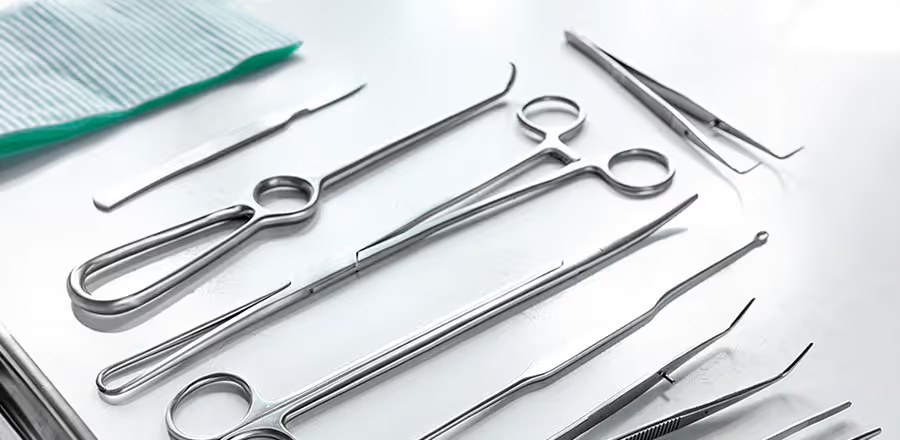
Arthrex iBalance Injury Lawsuits
Investigating knee replacement complications
Thank you for considering The Lyon Firm. At this time, we are not accepting plaintiffs related to this specific consumer issue. However, if you would like to be contacted in the future, please complete the contact form. By completing the form you will be contacted if the Firm begins accepting new cases on this matter, and you will also be included in firm news alerts related to important consumer safety and privacy issues to help keep you informed about related issues.
In February, 2016, the U.S. Food and Drug Administration (FDA) announced a recall for the Arthrex iBalance knee replacement device due to issues with a defective tibial tray causing loosening and implant failure. The FDA said almost 2,400 Arthrex iBalance units were affected by recall which may have been implanted in patients across the U.S.
Following the knee replacement recall, Arthrex stated that the devices “reported to have a smooth texture to the outer surface of the metal, which differed from a previous that had a textured outer surface.” In short, the device is defective and incompatible with other knee replacement components. The result is a number of patients with a defective device implanted in their knee, which is likely to fail and cause serious complications.
Patients may need revision surgery if their implant Arthrex iBalance knee replacement fails or loosens. The most common sign of failure is knee pain or knee instability, often the result of poor bonding between the metal implant and the knee.
Joe Lyon is a highly-rated product liability lawyer representing plaintiffs nationwide in a wide variety of Defective Medical Device and civil litigation claims.
Failing Arthrex Device Lawsuits
The Arthrex iBalance Tibial Tray is part of the Arthrex iBalance Total Knee Arthroplasty System. It was created for the purpose of treating multi-compartmental knee cartilage degeneration caused by osteoarthritis or post-traumatic arthrosis. Arthrex marketed the iBalance as an alternative to other total knee replacements, and it is meant to reduce the need for later surgeries to have metal plates and screws removed.
However, patients are finding out that because there are issues with Arthrex knee replacement devices, the potential complications make it necessary to have a revision surgery.
So although the Arthrex iBalance implant was originally intended to reduce the need for further operations, patients must undergo additional surgeries in the end. Knee replacement patients who require additional surgeries face an increased risk of post-op infection, tissue damage, nerve damage, bone loss and other complications.
Patients also face time away from work and lost wages, as well as a painful recovery and rehab period. Compensation for medical costs and other damages can be recovered by filing a claim against a negligent manufacturer of a defective medical device.
Arthrex iBalance Device Failure
- Chronic Pain—some level of pain is normal after an implant operation, but if the pain continues or worsens, and you notice a constant throbbing, you could be suffering from a defective device.
- Inflammation—knee ligaments and surrounding tissue may become inflamed when a defective knee device causes friction. This results in a build-up of fluid, swelling and further immobility.
- Instability—if you stand or walk and notice an unstable knee soon after a knee device has been implanted, you may be experiencing a defective product.
- Implant Loosening & Fracture—patients have reported that they can feel when knee implant components are loose or detached.
- Warmth felt in Knee—abnormal sensations following surgery are common, but if you feel warmth or heat in your knee months later, this may be a sign of a failed knee implant.
- Bone Fracture—device failure can lead to structural damage like a bone fracture if a defective knee system puts too much pressure on the knee.
- Failure to Bond—implants may detach from the bone when defects are present.
- Mobility Issues—if you notice a decreased range of knee motion in the weeks or months following a knee replacement, the device may not be functioning as intended.
- Revision Surgery—when a defective device is implanted and begins to cause problems, it will require a revision surgery to remove and replace the faulty components.
- Other Serious Complications—Defective knee replacement systems can lead to complications like blood clots, bone loss, tissue damage, nerve damage, infections, and metallosis.
Knee replacement surgery is often recommended to restore mobility and reduce pain caused by arthritis or injury. While most procedures are successful, defective knee implants have left many patients with painful complications and the need for revision surgery. In such cases, patients may be eligible to pursue a defective knee replacement lawsuit.
Common Problems with Knee Implants
Defective knee replacements can fail much earlier than their expected lifespan, sometimes within just a few years. Complications may include loosening of the implant, fractures, misalignment, or severe pain that limits mobility. These issues often require revision surgery, which is typically more complex and risky than the initial procedure.
Legal Grounds for Filing
Lawsuits against knee implant manufacturers are usually based on design defects, poor manufacturing quality, or failure to warn about known risks. If a device was marketed as safe and durable but failed prematurely, patients may have grounds for legal action.
Compensation Available
A successful knee replacement lawsuit can provide compensation for medical expenses, lost wages, rehabilitation costs, and pain and suffering. In some cases, punitive damages may also be awarded to hold manufacturers accountable for negligence.
Taking the Next Step
If you or a loved one suffered complications from a defective knee implant, consulting an experienced product liability attorney is essential. These cases are complex and often involve large medical device companies. Legal guidance can help you secure the compensation and accountability you deserve.
Experienced. Compassionate. Consumer Advocates
The Lyon Firm is a Cincinnati, Ohio-based law firm, representing individuals nationwide in class action, product liability, and toxic exposure litigation.

Handling Complex Data Privacy & Cyber Security Cases
Request A Free Consultation Now

.avif)
Why are these cases important?
Defective medical device litigation helps to improve patient safety and holds medical device companies accountable when defective products injure plaintiffs and clients.
Questions about Knee Replacement Injuries

A defective medical device is one that poses unreasonable danger during its normal use. Legally, defects fall into three groups: design, manufacturing, and marketing. Design defects make the product inherently unsafe, while manufacturing errors occur when mistakes compromise safety. Marketing defects stem from incomplete warnings or unclear usage instructions. A defective device may include an implant that deteriorates too soon or a diagnostic tool that produces unreliable readings. Courts examine whether the risks were foreseeable and properly disclosed. If the device causes harm under expected use conditions, it may be classified as defective under product liability law.
Defective design medical device cases arise not because a mistake was made during the manufacturing process, but rather the original design of the product is unreasonably dangerous. A “risk-benefit analysis” is used to determine whether safer/less expensive alternative designs were available to the manufacturer (e.g. the metal on metal design, the porosity and stiffness of transvaginal mesh )
For these claims, the FDA Review process is critical on whether a pre-emption defense exists. For devices that went through the PMA (pre-market approval process), rather than the 510K process, the case must be evaluated very carefully for any parallel claims under state and federal regulations (e.g., failure to warn or failure to disclose adverse events) that can advance the case forward. Without a careful legal analysis, the case may be subject to dismissal even where the medical device design proves to be defective.
Risks: The following factors are considered under Ohio law when determining the risks associated with the design of a medical device: (1) the magnitude of the risk of injury; (2) ordinary consumer awareness of the risk for injury; (3) the likelihood of causing injury; (4) the violation of a private or public standard; and (5) the consumer’s expectation of the performance of the product and level of danger. Ohio Revised Code 2307.5 (B) Product Defective in Design or Formulation. These factors are considered in most other jurisdictions.
Benefits: The following factors are considered under Ohio law when determining the benefits associated with a medical device: (1) the utility of the product; (2) availability of an alternative design; (3) the magnitude of risks associated with an alternative design. Ohio Revised Code 2307.5 (c) These factors are considered in most other jurisdictions.
Defenses for Defective Design: (1) a pharmaceutical drug or medical device is not defective by design if it contains an adequate warning of an unavoidably unsafe aspect of the pharmaceutical or medical device; (2) the dangerous aspect is inherent to the product, recognizable, and cannot be eliminated without compromising the product’s usefulness; (3) a lack of a feasible alternative design. 2307.75 (d)(e)(f).
A manufacturing defect claim arises where the medical device is released from the factory in a manner that deviates from the intended design or specifications.
Most manufacturing defect cases are based on a products deviation from the intended specification, formula, performance standards, or design model. In such cases, it may be easy to determine the product did not comply with the intended design. In defective medical device cases, the manufacturing defect is often related to performance standards (e.g., the metal does not meet the strength specification or has microscopic fractures–these defects require an examination by a qualified metallurgist who can examine the medical device).
As a result of the deviation, the product enters the market in an unreasonably dangerous condition and the consumer is exposed to or purchases a product that is defective. Any personal injuries or economic loss that arise from the the defect are compensable under Ohio product liability law.
The product may be recalled as a specific lot is identified as being non-compliant and defective. A product may be defective in manufacture or construction, materials and assembly, and a manufacturer or distributor may be subject to strict liability, even though it exercised all possible care. Ohio Revised Code 2307.74.
Design and manufacturing defects result in medical device product recalls each year in the United States, initiated by federal safety agencies.
These government agencies may initiate recalls of dangerous products but do not provide remedies or compensation for damages where an individual is injured due to the defective product. Only litigation can compensate patients injured by a defective medical device.
The Lyon Firm is an excellent choice for those seeking accountability and justice in difficult legal matters. Joe Lyon brings years of trial experience in cases involving defective products, toxic exposure, and consumer rights. The firm is well-regarded for its ability to take on corporations and win significant results for clients. Beyond results, The Lyon Firm values open communication and client trust. Joe Lyon personally guides clients through each legal step, ensuring they feel supported throughout the process. Hiring The Lyon Firm means partnering with a law practice dedicated to justice, fairness, and protecting those who need it most.
Medical Devices Lawsuits
Request a Free Consultation
Taking the first step doesn’t have to be complicated. In just a few minutes, you can share the basics of your case, and our team will guide you from there:
- It begins with a few simple questions about your situation.
- From there, a member of our legal team reviews your case.
- Together, we’ll chart the path forward, helping you take the next step toward resolution.
