

Airbag Failures | Auto Defects
Nationwide Representation


.avif)


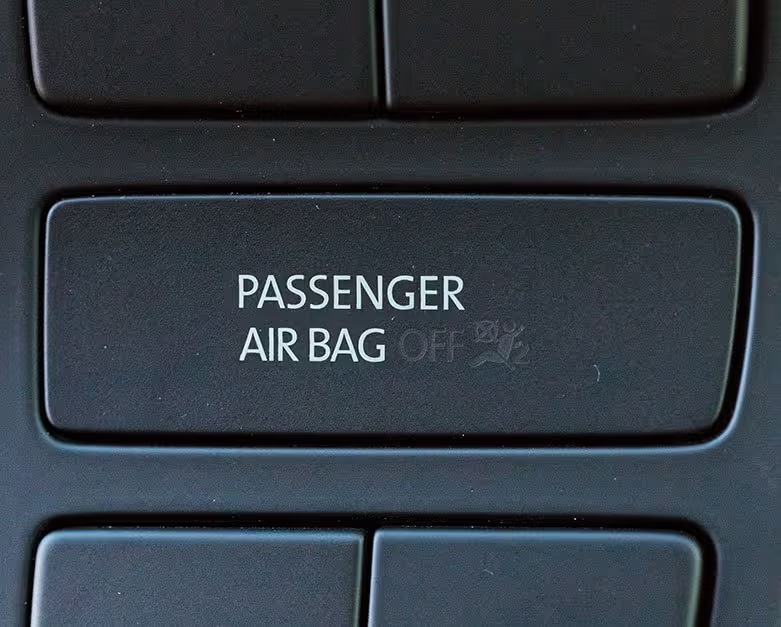
Defective airbags may not deploy in the event of an accident or collision. Other defective airbags deploy inadvertently and cause an accident. Other airbag defects reported include delayed airbag deployment and non-deployment, leading to severe injury.
Since the National Highway Traffic and Safety Administration began recording crash statistics, many American motorists and passengers have passed away as a direct result of defective airbags. However, these are only the reported events. Many additional deaths and disabling injuries have been linked to defective airbags through litigation.
In addition, the National Highway Traffic Safety Administration recently updated its list of vehicles that contain airbags that can kill drivers or passengers when the defective airbags are released. The number of vehicles with immediate risk of these dangerous airbags stands in the tens of millions.
A recent investigation includes a deep dive into the airbag safety of vehicles assembled by Honda Motor, Ford Motor Co, ,Toyota Motor Corp, General Motors Co, Nissan Motor, Subaru Tesla, Ferrari NV, Nissan Motor, Mazda, Daimler AG, BMW Chrysler, Porsche Cars, Jaguar Land Rover (owned by Tata Motors) and others.
These vehicles have Takata airbags that may shoot metal when airbags are inflated, release with too much force, or not release at all. Four people have already died from this severe issue. Medical professionals initially thought one woman’s death was a stabbing.
How are Airbags Defective?
Airbag inflators house a propellant that turns into a gas that fills an airbag when triggered by a collision. If the inflators rupture, as reported, metal fragments may strike vehicle occupants like shrapnel, causing serious injuries.
The defect in these airbag inflators creates openings that allow moisture to leak into them, reaching the ammonium nitrate and creating a safety risk.
Airbags unquestionably have saved lives. However, airbags that are not functioning properly can not only provide a false sense of security but can contribute to and even be the primary cause of an injury or death.
Design defects, negligent auto repairs, and manufacturing defects have all been suspected in airbag defect lawsuits. Airbags can be recalled to due any of the following defective parts:
- Sensors: non-deployment
- Dangerous Inflation path (upward and then outward is the safest path for the release of an airbag)
- Overly-powerful inflation (unnecessarily forceful impact)
- Internal Tethers (affecting the shape the airbag is released in)
- Release of metal fragments
- Delayed Airbag Deployment
- Inadvertent Airbag Deployment
What is Airbag Non-deployment?
If an airbag fails to deploy, obviously all further safety bets are off. Manufacturing defects, design defects and negligent auto repairs have all been suspected in defective airbag lawsuits.
Generally, an airbag will deploy when a sufficient force hits a threshold and initiates the release of the airbag. But there may be defective sensors in an automobile, and an airbag may not deploy at all, or may deploy only partially or late. In such cases, death, severe injuries like traumatic brain injuries and permanent disabilities are possible.
Manufacturers can improperly design, test, or install sensors. Failures in software or calibration of the airbag firing threshold can cause an airbag sensor to not detect a collision. Other causes of airbag non-deployment may include:
- Airbag Module Defect: a defective airbag module may prevent an airbag from firing during an accident. This is most likely the result of inherent design or manufacturing defects.
- Poor airbag design
- Cheap construction materials
- Negligent manufacturing
- Auto Repair Negligence
- Faulty Steering Wheel Wiring
- Corroded or severed electronics: Airbag failures can occur when manufacturers choose to run wires through areas that make them vulnerable to being severed during a crash. If sensor wiring is damaged or severed, signals will fail to reach the airbag module and it will not deploy.
- Defective software
- Improper testing & quality control
Airbag Defects
The National Highway Traffic Safety Administration (NHTSA) has repeatedly warned that tens of millions of cars with Takata airbags face an increased risk of exploding during a collision after prolonged exposure to warm weather and humid conditions.
The NHTSA says, “Long-term exposure to high heat and humidity can cause these air bags to explode when deployed. Such explosions have caused injuries and deaths.”
In the United States, there are 50 million defective Takata airbags in 37 million vehicles. Many of them are in states such as Texas, California, and Ohio, where hot, humid summer weather can cause the chemical propellant in defective Takata airbags to explode.
Any vehicle with a defective airbag may be a safety risk, and the NHTSA has warned that more vehicles will soon be recalled, bringing the total number of recalled Takata air bags to between 65 million and 70 million by 2019.
Who Has Recalled Airbags?
Six automobile makers were involved in the initial Takata recall. The issue quickly engulfed 19 automakers, and Takata was soon inundated with hundreds of lawsuits. The company failed to act quickly, and more accidents were reported. Takata said it had little idea as to which cars used its defective inflators, or even what the root cause was.
Takata first explained that propellant chemicals were improperly stored during assembly, causing metal airbag inflators to burst open due to excessive pressure inside. Then, the company blamed humid weather which was accompanied with additional recalls.
Takata has now admitted that rust and bad welds on inflators are also at fault. Company documents show that Takata’s Mexico plant allowed a defect rate that was “six to eight times above” acceptable limits. Defective air bags were shipped and sold to millions of customers.
Takata, under fire for years, finally filed for bankruptcy-court protection in the U.S. and Japan, as the company faces billions of dollars in legal liabilities resulting from years of recalls and lawsuits.
Takata’s recalled air bag inflators have been linked to at least 180 injuries and 20 deaths. Automakers such as Ford, Nissan, Toyota, Honda Motor and Mazda have paid huge settlements to settle personal injury and product liability claims. It is the largest auto recall in United States history.
Honda & Takata Air Bag Recalls
Honda Motor recalled over 1 million Acura and Honda vehicles in the U.S. with defective air bag inflators that potentially could explode and send sharp metal into the vehicle, endangering drivers and passengers. Honda announced the recall of Takata airbags, which is a part of the largest auto recall in U.S. history, involving 50 million defective air bags, according to the U.S. National Highway Traffic Safety Administration (NHTSA).
The NHTSA has said that 15 people in the United States have been killed by faulty Takata air bag inflators, and possible hundreds have allegedly been injured following car collisions when airbags fail to deploy or explode and injure passengers.
Due to electrical noise, a component in the air bag control module may fail causing the front air bags, side curtain air bags, and/or seatbelt pretensioners to deploy inadvertently while the vehicle is being operated.
The NHTSA has followed Takata’s air bag recalls and investigated the company’s negligence for several years. In one case, Honda found defective air bag inflators made at a Takata facility in Mexico in which the company “manufacturing process errors” resulted in excessive moisture into the inflator.
According to Honda, the moisture produced a high amount of pressure, causing it to rupture. The potential airbag explosions sent pieces of metal into the vehicle and injuring passengers.
Experienced. Compassionate. Consumer Advocates
The Lyon Firm is a Cincinnati, Ohio-based law firm, representing individuals nationwide in class action, product liability, and toxic exposure litigation.

.avif)
Why should I hire The Lyon Firm?
Joe Lyon is a highly-rated auto recall attorney and Auto Defect lawyer who has successfully represented plaintiffs throughout the United States in multiple complex product liability cases. These cases are generally filed in Federal Court, though State Court options may be available in certain cases.
If you or a family member have been injured by a recalled airbag device and need a defective airbag lawyer, contact The Lyon Firm today for a no-cost consultation at (513) 381-2333 to learn more about your legal rights.
Understanding Airbag Defect Cases

Consumers can follow airbag recall news or search for current and past airbag recalls on the Website of the NHTSA, as well as on other car safety advocate outlets. Look on your car windshield for a 17-character Vehicle Identification Number. Your VIN is also located on your car’s registration card.
If your car is listed on a recall notice, contact your dealer and an auto defect attorney.
If your car has been recalled and you have suffered an injury, contact an auto defect attorney to investigate a potential claim
If you have been injured by a defective airbag that failed to deploy or deployed inadvertently and caused injury, you may have a valuable product liability claim. Settlements are likely in the event of an airbag defect leading to consumer injury.
Your Auto Defect Lawyer is dedicated to holding auto companies accountable when they fail to properly test safety features and release defective products that injure the American consumer.
The Lyon Firm has filed numerous product liability and class action lawsuits against large auto companies and car makers for endangering consumers with defective airbags and other faulty auto components.
By holding companies responsible for their negligence and putting American drivers at risk, Joe Lyon and plaintiffs aim to reach a sizable settlement and make the roads safer in the future.
When crucial safety features fail to function as they were intended, serious injuries are likely. If airbags fail to deploy or deploy when they shouldn’t they may be responsible for consumer injuries.
As of December 2020, about 10 million affected airbags remain on America’s roads. Even some replacement airbag inflators have been recalled with the same rupture risks.
People injured by Takata airbags can file claims for compensation through funds that were created to compensate victims. Contact The Lyon Firm to learn more.
Auto manufacturers and car makers can be held liable in airbag defect lawsuits. Many automakers outsource some of their production and may not always be aware of some defects. Honda, for example, purchased all their defective airbags from Takata.
Faulty wiring within the steering wheel is suspected in many airbag deployment injury cases. A short circuit may cause the air bags to become disabled or inadvertently deploy. An inadvertent airbag deployment can increase the risk of injury or the possibility of a crash.
An inoperative airbag can increase the risk of injury in a severe crash. The power steering assist could also become inoperable resulting in increased steering effort and can increase the risk of a crash at low speeds.
On October 16th, 2014, Honda Motor Company opened its records to a third party investigation firm after allegations that the company was covering up its information regarding the true numbers of deaths and injuries associated with the Takata airbag recall incident. The Center for Auto Safety is responsible for the allegations and has based them on reports by similar automakers who have identified many more cases.
GM and Toyota have reported around 1,700 incidents each, whereas Honda has only reported 28. Honda’s defense is that under the TREAD Act, it is only required to report written, not verbal, complaints. However, the Center for Auto Safety is arguing that there are still written statements which have not been cited. Law360 reports.
On October 29th, 2014, consumers began to take legal action regarding the faulty airbags. Class action suits were filed in both Florida and California. The attorney for the Florida plaintiffs alluded to the trials ending up in Florida, since so many cases are suspected to be filed there; the state is expecting a large influx of these lawsuits against Takata because the humidity in this region (including Puerto Rico) makes the defective airbags explode more frequently.
The Florida judge set December 8th for a “hearing on the motion of expedited discovery”; the urgency stems from the plaintiff’s argument that these airbags may lead to further deaths if not handled properly and promptly. Law360 reports.
On October 30th, 2014, a Hawaiian Honda driver filed a potential class action in Los Angeles federal court against Takata Corporation and Honda Motor Company.
Furthermore, the NHTSA has ordered Takata to turnover several of their documents on airbags, including correspondence between Takata and motor companies regarding their recalled products.
Critics argue that the NHTSA should have taken such action in July at the latest. The NHTSA Deputy Administrator said they want Takata to release documents and answer questions under oath regarding the discrepancies involved in their airbags.
On November 7th, 2014, Californians hit Takata Corporation with yet another class action. The suit is brought against the company, alleging that it destroyed evidence, including videos and computer backups, that showed their airbag defects.
There are eight named plaintiffs from California, New Jersey, Ohio, New York, Virginia, and Washington. The New York Times reported that former employees alluded to lab technicians being told by the company to destroy testing data that “showed cracks in the steel casings that house their airbag inflators.” Law360 reports.
On November 17th, 2014, a Florida family filed a lawsuit against Honda Motor Company and Takata, Inc. for issuing their recall of explosive air bags much too late. According to Law 360, Hien Thi Tran died in late September due to an accident in which the air bag deployed and sent sharp shrapnel all throughout her body.
The wounds were so bad that medical personnel initially thought she had been stabbed and police initially looked into her death as a homicide. This suit is coupled with numerous others that are springing up all over the country, and can be handled by a defective airbag lawyer.
Auto Defect Lawsuits
Request a Free Consultation
Taking the first step doesn’t have to be complicated. In just a few minutes, you can share the basics of your case, and our team will guide you from there:
- It begins with a few simple questions about your situation.
- From there, a member of our legal team reviews your case.
- Together, we’ll chart the path forward, helping you take the next step toward resolution.
