

Seat Belt Failures | Auto Defects
Auto Defects & Recalls


.avif)


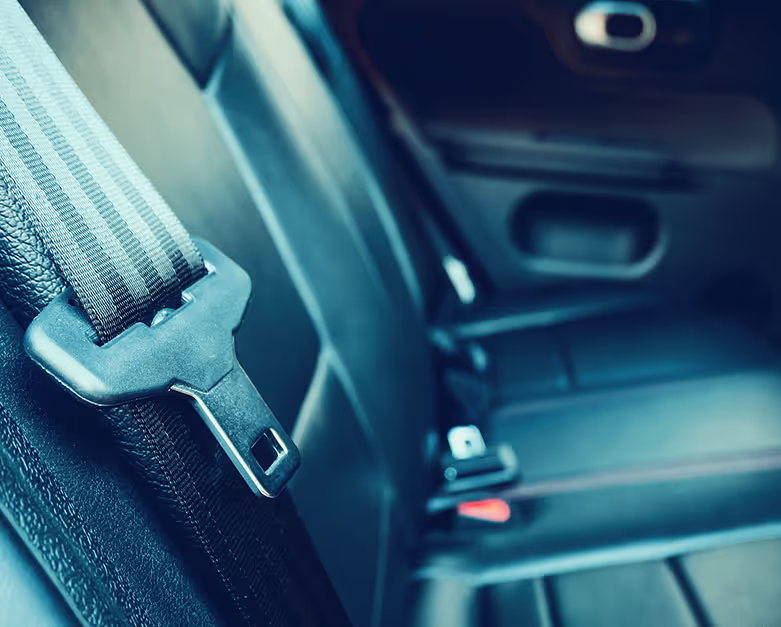
There is no denying that safety belts save thousands of lives each year in the United States. Some statistics suggest wearing a seat belt may cut the front-seat risk of fatal injury by up to 50 percent.
However, many passengers involved in accidents wearing their safety belts still sustain serious injuries and may be killed if the seat belt does not function as intended. When issues of seat belt effectiveness arise, and victims of traffic accidents are injured or killed, legal action against an automaker is a likely course to consider.
Auto passengers understandably rely on certain safety features when accidents occur on the road. In times when factory-installed safety features like airbags and seat belts do not work properly, the corporations and manufacturers of those defective products must be held responsible.
Joe Lyon is a highly-rated product liability lawyer representing plaintiffs nationwide in a wide variety of consumer product liability and automobile defect cases.
The Firm has extensive experience in investigating and litigating seat belt failures and defects. Contingency fees are offered on all cases.
Types of Seat Belt Failures & Defects
- Unlatching & False Latching: During a collision, a seat belt may become unlatched, allowing the latch plate to pull out of the buckle. Some in the auto industry deny that a seat belt can instantly unlatch, though recent testing has demonstrated that seat belts may be susceptible to this phenomenon. False latching occurs when the latch plate appears to be latched when inserted into the buckle but is actually not engaged, and the smallest amount of force can cause the buckle to release.
- Torn or Ripped Belt Webbing: Seat belt webbing is designed to withstand the forces of an accident without ripping or tearing. So when there is evidence of damaged webbing, it could be a result of a material defect or manufacturing flaw.
- Retractor Failure: The seat belt retractor is designed to lock the seat belt in place in the event of an accident. But retractors have been known to fail to lock because of design defects, potentially causing serious injury to passengers.
- Excessive Spooling: Spooling occurs when an excess amount of the seat belt webbing is released during a collision. Instead of securing an occupant, the seat belt slackens. This defect is typically due to a faulty retractor.
- Poor Seat Belt Design: Poor safety belt design can contribute to serious passenger injuries, particularly in rollovers. The safest belt anchor location is on the seat itself, but many vehicles have anchors placed on the vehicle floor, often behind the occupant’s seat.
- Software Defect: With automobiles increasingly reliant on computer-engaged safety features, drivers and passengers are at the mercy of these integrated systems. Even seat belts may not function properly if there is a defect in the car’s computer software.
- Entire System Failure: Seat belts are only as safe as the vehicle’s seats and surrounding structure. If the seats fail, safety belt effectiveness is significantly reduced or nullified completely.
Seat Belt Unbuckling Safety Hazards
Recently, Ford Motor Co. recalled around 117,000 vehicles due to unstable bolts in car seats, and concern that seat belts or buckles could fracture.
The company said in a statement that inadequate rivet head thickness in the seat bolts could allow statement of seat belt buckles from their mounting bracket during a collision. Ford admitted that this increases the risk of injury in the event of an accident.
Ford says if bolts fracture, the seat or the seat belt’s performance could be compromised in a sudden stop or collision.
Ford also issued a safety recall for Ford Focus vehicles due to an improperly installed left-side seatback frame. The company noted that inadequate weld penetration between the outboard pivot bracket and the pivot nut joint could endanger passengers in the event of an accident.
Consumers have the right to rely on seat belts and other car safety features. However, design and manufacturing defects are all too common and have serious consequences for drivers and passengers. As a result, the manufacturers of components or distributors may be held accountable for any damages and injuries.
Seat belts that unbuckle, rip, tear or dissemble under the stress of an accident are deemed defective. Considering safety belts are some of the most important safety features of a car, a manufacturer should face legal action if they do not comply with regular road safety guidance.
Identifying Defective Seat Belts
Evidence that a seat belt failed during a collision because of a design or manufacturing defect is often subtle and can be difficult to identify in the wake of the accident. If a belt failure is suspected, however, it is important to preserve the vehicle and the seat belt system as much as possible for legal evidence.
Each accident is different, and presents numerous factors that may require specialists, collision engineers and legal experts to determine what contributed to an injury or fatality. The following circumstances may help to detect a defective safety belt:
- A passenger wearing a seat belt makes contact with the windshield.
- Serious injuries are sustained to a belted passenger in a minor collision.
- The seat belt webbing is found torn or ripped.
- An injured passenger is discovered wearing a loose-fitting seat belt.
- A passenger is found unbelted but insists he or she was secured in a seat belt.
- Two belted passengers in the same vehicle endure an accident and one passenger suffers much worse injuries than the other.
Seat Belt Design Defects
Design defects may be the primary issue. Lap seat belts and three-point seat belts are the most common types of safety belts used in the vehicles. A lap seat belt is a two-point strap, going over one’s waist/pelvic area, which should remain on the pelvis during accident sequences and is designed to hold a person in a car seat. Seat belt syndrome is often mentioned in the association with the lap seat belts use in the vehicles.
According to CPSafety, lap belts are perfectly safe, when used to install a harnessed child safety restraint. However, they provide poor protection to the lap belted person, endangering neck, head, spine and internal organs. This articles addresses those risks and ways to limit them.
By definition, a seat belt, also known as a safety belt, is a safety strap or harness, designed to hold a person in a car or aircraft seat securely and prevent the forward motion in case of collision.
The National Traffic and Motor Vehicle Safety Act provides that NHTSA has the authority to issue vehicle safety standards, as well as to request car manufacturers to recall the vehicles with the identified safety-related issues for correction.
Laboratory test procedure no. 209 from NHTSA includes the following general requirements for the seat belts assemblies to achieve their basic purpose of preventing forward motion in a collision.
- A seat belt assembly should be designed for use by only one person at one time;
- A seat belt assembly should ensure upper torso restrain without shifting the pelvic restrain into the abdomen;
- Vertical forces on the shoulders and spine should be minimized;
- Hardware parts should not contain burrs or sharp edges;
- Seat belts should be supplied with the buckle readily accessible to a person, ensuring quick and easy removal of the seat belt assembly;
- Buckle release mechanism should exclude the possibility of accidental release.
Risks of Submarining In Lap Belt Defective Designs
Submarining or moving down and forward into the seat during the accident is another risk, associated with the use of seat belts. In this situation, the lap belt moves from pelvis to the abdomen and can cause serious injuries to the internal organs of the abdomen area.
There were several ideas suggested to solve the problem and reduce submarining risks. Thus, some car seats have metal bars beneath the car seat cushion. Another inventor suggested using a small air-bag located in the seat cushion to prevent sliding of the driver or passenger beneath the safety belt.
Car engineers have developed a whole range of car safety devices and systems to safely protect passengers during a collision and accident forces. Experts generally define active and passive car safety devices, where active safety is mostly referred to the systems and devices, which help prevent a crush or collision (for example, brakes), and passive safety is mostly associated with the devices, such as seat belts and airbags, which help protect car occupants during a crush.
Passive safety devices are often mentioned as the vehicle restraint system, because their major task is to prevent unsafe movements of occupants during a crush and thus avoid personal injury damages from hitting a steering wheel, windscreen, or dashboard. Ideally, the seat cushion, safety belts and airbags should work as one unified restraint system to protect people.
Lap Seat Belts & Three-point Seat Belts
Lap seat belts and three-point seat belts are the most common types of safety belts used in the vehicles. A lap seat belt is a two-point strap, going over one’s waist/pelvic area, which should remain on the pelvis during accident sequences and is designed to hold a person in a car seat.
Three-point seat belts have three points of mounting: two at either side of one’s waist area, and the third one – behind the shoulder. Three-point seat belts are considered to be a standard equipment in the modern car-making industry since 2004, and they provide far more protection during a car crush in comparison to the older lap seat belts because they full restrain the upper torso. However, lap belts are still present in many older cars.
Seat Belt Defects & Seat Belt Syndrome
Seat belt syndrome is often mentioned in the association with the lap seat belts use in the vehicles. According to CPSafety, lap belts are perfectly safe, when used to install a harnessed child safety restraint. However, they provide poor protection to the lap belted person, endangering neck, head, spine and internal organs.
Seat belt syndrome is typically associated with the following injuries:
- Abdominal organs damages
- Bowel rapture
- Lumbar spine fractures
- Ruptured Liver
- Closed head and facial injuries
Defective Seat Belt Lawsuits
According to the National Highway Traffic Safety Administration (NHTSA), seat belts save 9,500 lives in the USA each year. However, seat belts can fail for a variety of reasons. Often seat belt failures result in severe and catastrophic injury.
Seat belt recalls are not uncommon at all when seat belt design standards are ignored or forgotten by car makers. Indeed, over 390 million cars, trucks, buses and other vehicles have been recalled since 1966 because of the identified safety issues either voluntarily by manufacturers or after lawsuits.
Compensation for Victims of Defective Seat Belts
If you have been injured in a car accident and suspect it may have been due at least in part to a defective seat belt, it is critical to preserve the evidence and contact an experienced attorney as soon as possible.
An experienced product liability lawyer can assist in evaluating contributing causes of an injury. To build a compelling product liability case, there must be evidence that the design of the seat belt was defective or a manufacturing defect existed.
The Lyon Firm works with design experts and collision engineers to trace the defect back to a design or manufacturing source. Compensation may be awarded for incurred and future medical expenses, pain and suffering, lost wages, as well as punitive damages against an automaker for disregard for the road safety of passengers.
Experienced. Compassionate. Consumer Advocates
The Lyon Firm is a Cincinnati, Ohio-based law firm, representing individuals nationwide in class action, product liability, and toxic exposure litigation.

.avif)
Legal Representation for Seat Belt Failures and Defects
Seat Belts are one of the most crucial safety features of any vehicle on the road, and yet there have been hundreds of cases of defective seat belts that lead to injury and deaths when an accident occurs.
Consumers may take the safety of their cars for granted, and assume their seat belts will function as intended. But due to design defects and poor production, some seat belts will fail.
The Lyon Firm focuses on product liability litigation and works with auto industry experts to determine the root cause of seat belt failure. If you have been injured as a result of a defective seat belt, contact The Lyon Firm to review your case.
Questions about Seat Belt Failure & Defect Cases

Consumers can follow recall news or search for current and past recalls on the Web sites of the NHTSA, as well as on other car safety advocate outlets. Look on your car windshield for a 17-character Vehicle Identification Number. Your VIN is also located on your car’s registration card.
If your car has been recalled and you have suffered an injury, contact an auto defect attorney to investigate a potential claim
You may not be aware that your car is defective. It is not always obvious when your seat belt or other safety component fails to function as intended. It can take an expert in auto engineering to determine what contributed to an accident or injury.
You can contact The Lyon Firm, and we will work diligently to review your auto accident case. If an auto defect was in part responsible for an auto injury, a lawsuit can be filed and a large settlement is likely.
If negligent manufacturers and automakers are directly responsible for an auto-related injury, a product liability and personal injury lawsuit may be filed and compensation may be recovered for accident victims. Plaintiffs may seek compensation that may include property damages, past and future medical expenses, lost wages and future earnings, and pain and suffering.
The Lyon Firm takes pride in representing consumers to make America’s roads safer by holding negligent auto manufacturers accountable for auto defects that lead to accidents and injuries. When car makers fail to institute basic safety measures and fail to test auto components before releasing cars tot he public, they may be targeted in product liability lawsuits.
Auto defects have been known to cause accidents in tire failure, tread separation accidents, brake malfunction and sudden acceleration cases.
Auto defects may not cause every accident, but they can play an integral part in causing injury in the event of an accident. This is common in defective seat back collapse, seat belt defects and airbag defects. When these crucial safety features fail to function as they were intended.
Auto manufacturers and car makers can be held liable in auto defect lawsuits. Many automakers outsource some of their production and may not always be aware of some defects. Honda, for example, purchased all their defective airbags from Takata.
Some defective auto part suits name other defendants like negligent auto dealerships or auto repair shops who alter car parts or fail to properly repair automobiles and leave a serious safety risk.
The list of defective automobiles changes each year, and it is more likely that certain components are defective rather than an entire brand name. Nowadays many car makers use the same third-party suppliers, which compounds safety issues when a defective auto part is produced.
In recent years, the most common auto defects have been faulty airbags. Millions of cars were recalled for defective airbags. Other common auto defects are defective throttles, defective car software, and tire failures. Tire failure has been an issue in many car accidents and truck accidents.
Auto Defect Lawsuits
Request a Free Consultation
Taking the first step doesn’t have to be complicated. In just a few minutes, you can share the basics of your case, and our team will guide you from there:
- It begins with a few simple questions about your situation.
- From there, a member of our legal team reviews your case.
- Together, we’ll chart the path forward, helping you take the next step toward resolution.
