

Agent Orange Claims | VA Disability Benefits
Toxic Tort Attorney and VA Disability Lawyer reviews agent orange cancer claims for plaintiffs nationwide Request a No-Cost & Confidential Consultation


.avif)


What Is Agent Orange?
Agent Orange was a tactical herbicide used by the U.S. military during the Vietnam War to remove jungle foliage and destroy crops. From 1962 to 1971, millions of gallons were sprayed across Vietnam, Laos, Cambodia, and surrounding areas. Agent Orange contained dioxin, a toxic chemical linked to serious long-term health conditions.
Veterans who came into contact with contaminated soil, water, or equipment were often unknowingly exposed. Decades later, many of those veterans suffer from cancers and disabilities tied to their service.
Who Qualifies for Agent Orange Benefits?
Eligibility is based on service location, time frame, and medical diagnosis. Veterans in the following categories may qualify:
Vietnam War Veterans
- Boots-on-the-ground service in Vietnam between January 9, 1962, and May 7, 1975.
- Service in inland waterways (so-called “Brown Water” Navy).
Blue Water Navy Veterans
- Served on U.S. Navy or Coast Guard ships within 12 nautical miles of the Vietnam coast during the war.
- Eligible under the Blue Water Navy Vietnam Veterans Act of 2019.
Korean DMZ Veterans
- Served in or near the Korean Demilitarized Zone between September 1, 1967, and August 31, 1971.
Air Force & C-123 Crew Members
- Flew or worked on C-123 aircraft that sprayed Agent Orange after the Vietnam War.
Other Areas of Exposure
- Certain veterans stationed in Thailand, Laos, or Cambodia, where spraying occurred.
- Some civilian contractors may also qualify under special programs.
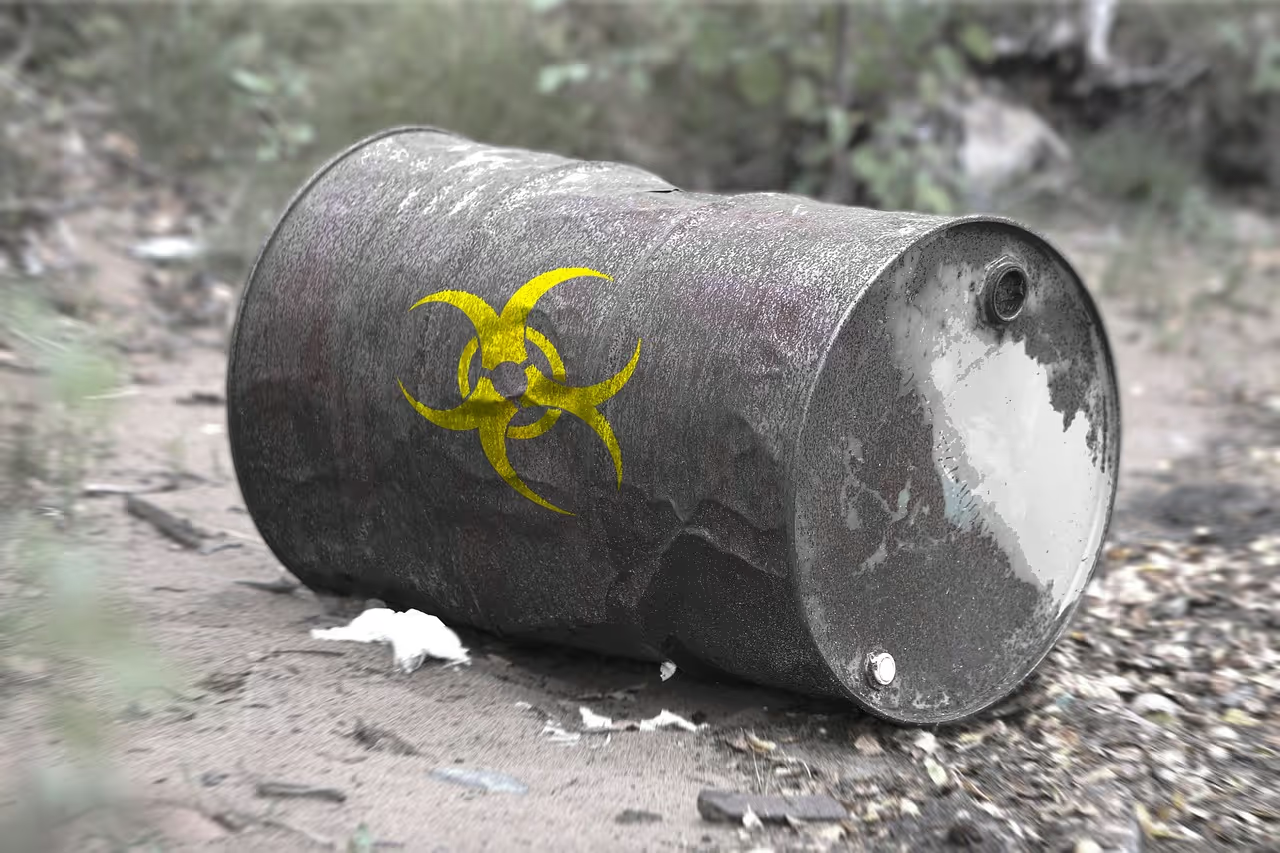
Over a ten-year period, the U.S. military dropped around 20 million gallons of toxic herbicide across 4.5 million acres of Vietnam, Laos and Cambodia. The mission was called Operation Ranch Hand, and used toxic herbicides to defoliate the heavy forest. The most well-known toxin used is Agent Orange, the most common 55-gallon drum of dioxin found regularly on military bases during the Vietnam War.
In 1991, Vietnam War veterans saw the passage of the Agent Orange Act, which acknowledged that the chemical was strongly linked to various cancers and the development of other diseases for veterans.
The bill authorized VA health benefits to those exposed to the toxins, but at the time, the U.S. Department of Veterans Affairs’ definition of exposure only covered those who spent time on the ground in Vietnam, which excluded Blue Water Navy veterans who served off the coast, though also handled Agent Orange.
As of January, 2019, a Federal Court ruled blue water Navy veterans are now eligible for the same VA benefits.
Agent Orange Benefits Eligibility
Recent government funding has worked to extend VA health care and compensation to tens of thousands of Air Force, Navy and Marine veterans with Agent Orange-associated conditions. The Diseases and Conditions covered by the VA include the following:
- AL Amyloidosis—A rare disease caused when an abnormal protein, amyloid, enters tissues or organs
- Chronic B-cell Leukemias—type of cancer which affects white blood cells
- Chloracne (or similar acneform disease)—skin condition that occurs soon after exposure to chemicals. It must be at least 10 percent disabling within one year of exposure to herbicides.
- Diabetes Mellitus Type 2—a disease characterized by high blood sugar levels resulting from the body’s inability to respond properly to the hormone insulin
- Hodgkin’s Disease—malignant lymphoma (cancer) characterized by progressive enlargement of the lymph nodes, liver, and spleen, and by progressive anemia
- Ischemic Heart Disease—a disease characterized by a reduced supply of blood to the heart, that leads to chest pain
- Multiple Myeloma—a cancer of plasma cells, a type of white blood cell in bone marrow
- Non-Hodgkin’s Lymphoma—a group of cancers that affect the lymph glands and other lymphatic tissue
- Parkinson’s Disease—a progressive disorder of the nervous system that affects muscle movement
- Early-Onset Peripheral Neuropathy—a nervous system condition that causes numbness, tingling, and motor weakness. It must be at least 10 percent disabling within one year of herbicide exposure.
- Porphyria Cutanea Tarda—a disorder characterized by liver dysfunction and by thinning and blistering of the skin in sun-exposed areas. Must be at least 10 percent disabling within one year of exposure to herbicides.
- Prostate Cancer—one of the most common cancers among men
- Respiratory Cancers (including lung cancer)—cancers of the lung, larynx, trachea, and bronchus
- Soft Tissue Sarcomas (other than osteosarcoma, chondrosarcoma, Kaposi’s sarcoma, or mesothelioma)—cancers in body tissues such as muscle, fat, blood and lymph vessels, and connective tissues
Joe Lyon is an experienced toxic tort lawyer and VA Attorney reviewing Agent Orange Exposure Lawsuits and personal injury cases for injured veteran plaintiffs nationwide.
Blue Water Navy Vietnam Veterans Exposure
For major expense reasons, the VA opposes extending benefits to veterans who served on ships during the Vietnam War and have exposure-related ailments linked to Agent Orange.
Court papers show that the U.S. was aware that Agent Orange was toxic to those exposed to the chemical. Dioxins, byproducts of the herbicide manufacturing process, accumulates in fatty tissues, and can persist for hundreds or thousands of years, contaminating areas and can lead to cancer and various disabilities.
After the Vietnam War, blue water Navy veterans began noticing higher cancer rates and other diseases linked to Agent Orange. In 1979, a class-action lawsuit representing veterans was filed against the chemical companies and a $240 million settlement was reached.
Agent Orange exposure presents lifetime risks and in June 2017, 1,500 to 2,100 troops who served as flight and ground crews for aircraft that distributed the Agent Orange were added to the VA benefit roles. Reports showed Navy veterans could have been exposed to the toxins in drinking water and their laundry.
About 650,000 Vietnam veterans have made Agent Orange benefit claims, and now an additional 50-70,000 veterans are eligible for Agent Orange benefits.
Blue Water veterans argue the VA has been “cherry-picking” information from scientific reports to conclude there is no scientific basis to support extending Agent Orange-related benefits. Other experts on the subject think exposure was highly likely for all Vietnam veterans.
It is now not possible to quantify exposures for Blue Water and Brown Water Navy sailors or for ground troops, but contaminated water at the time was a major health concern.
Navy ships were provided potable water from barges operating from shore, where millions of tons of defoliant was dropped. Some American soldiers even used the empty 55-gallon drums for makeshift showers at camps.
Legal Action: Agent Orange Exposure Lawsuits
The Department of Veterans Affairs (VA) presumes that certain diseases were caused by exposure to Agent Orange and other herbicides.
Disability ratings are assigned in 10% increments, from 0% to 100%, based on severity of illness and impact on daily life. The higher the rating, the greater the monthly benefit. Veterans may also qualify for Special Monthly Compensation (SMC) if their disability results in loss of function or need for assistance.
Why Hire The Lyon Firm?
The VA disability claims process can be overwhelming, especially when dealing with serious illness. The Lyon Firm provides:
- Experience in VA Disability & Toxic Exposure Cases
Our firm has represented thousands of individuals harmed by toxic substances, including veterans exposed to Agent Orange. - Nationwide Representation
We assist veterans in every state with filing, appeals, and benefit recovery. - Appeals & Denial Assistance
If your claim has been denied or under-rated, we help build a strong appeal. - Contingency Fee Representation
Veterans only pay if we successfully recover benefits.
Experienced. Compassionate. Consumer Advocates
The Lyon Firm is a Cincinnati, Ohio-based law firm, representing individuals nationwide in class action, product liability, and toxic exposure litigation.

Handling Complex Data Privacy & Cyber Security Cases
Request A Free Consultation Now

.avif)
How to File an Agent Orange VA Disability Claim
Filing an Agent Orange claim can be challenging without guidance. Here are the basic steps:
- Gather Service Records
Prove you were in an eligible location and timeframe. - Obtain Medical Evidence
Secure medical records and a diagnosis of a presumptive condition. - Complete VA Form 21-526EZ
This form is used for new disability claims. - Submit to the VA
Claims can be filed online, by mail, or with the help of a VA-accredited attorney. - Await a Decision
The VA will review your claim, request additional information if needed, and assign a disability rating. - Appeal if Denied
Many Agent Orange claims are initially denied. Veterans have one year to file an appeal.
Questions about Agent Orange Exposure

If you meet service requirements in a presumptive area, you do not need additional proof.
You can file an appeal within one year. Many denials are overturned with stronger evidence.
Survivors of deceased veterans may qualify for Dependency and Indemnity Compensation (DIC).
VA Disability Lawsuits
Request a Free Consultation
Taking the first step doesn’t have to be complicated. In just a few minutes, you can share the basics of your case, and our team will guide you from there:
- It begins with a few simple questions about your situation.
- From there, a member of our legal team reviews your case.
- Together, we’ll chart the path forward, helping you take the next step toward resolution.
